
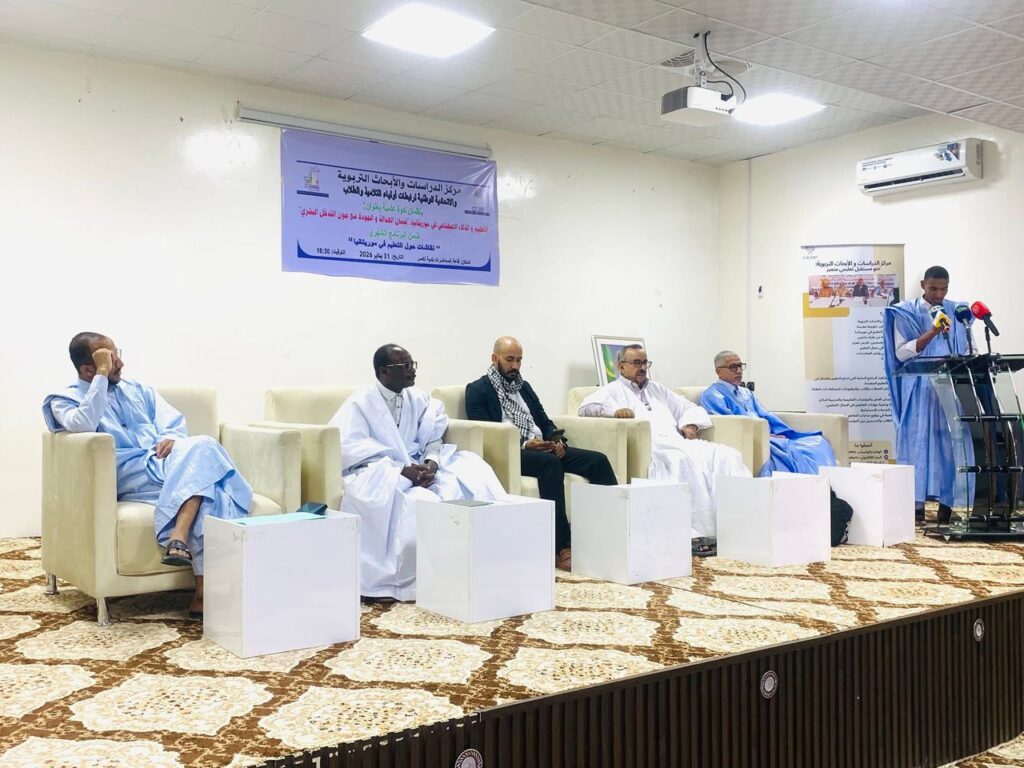
On the evening of January 31, 2026, the Center for Educational Studies and Research, as part of its monthly program of discussions on education in Mauritania, held a scientific and intellectual seminar at the Cultural Center of ksar Municipality. The seminar focused on the topic:
“Education and Artificial Intelligence in Mauritania: Ensuring Equity and Quality while Preserving the Role of Human Intervention.” This event commemorated International Education Day, which this year is observed amidst the rapid transformations the world is witnessing in the field of digital technologies and artificial intelligence, and the new challenges these transformations pose to educational systems, particularly in developing countries.
The seminar was attended by a group of stakeholders in the field of education, as well as representatives of local authorities and civil society. It opened with official remarks that emphasized the importance of a calm and responsible discussion on integrating artificial intelligence into education, moving beyond the logic of absolute rejection or unconditional acceptance.
In his opening remarks, the Deputy Mayor of Nouakchott, Najib, affirmed that education remains a cornerstone of sustainable development and that local communities are obligated to support all initiatives that contribute to the development of Mauritanian schools. He pointed out that artificial intelligence, if properly utilized, can represent a genuine opportunity to improve the quality of education and reduce disparities between educational institutions, provided it is integrated within a comprehensive national vision that preserves the school’s educational and humanistic role.
For his part, the Vice President of the Parents’ Association expressed the growing interest of Mauritanian families in the future of education, asserting that digital transformation must continue to serve the learner and not become a new burden or a cause of deepening social inequalities. He also stressed the necessity of involving parents in discussions concerning the introduction of artificial intelligence into schools, given its direct impact on the moral and behavioral development of their children. Dr. Ba El Houssein Hamadi, Vice President of the Center for Educational Studies and Research, focused his remarks on the role of scientific research in keeping pace with educational transformations. He argued that educational intelligence should not be imported as ready-made models, but rather developed based on field studies that consider the realities of education in Mauritania, its potential, and its structural challenges. He also emphasized the central role of the teacher as the primary actor in the educational process.
The keynote lecture, delivered by economist Mohamed Mahfoud Haddine, formed a central theme of the symposium. He addressed the close relationship between education and artificial intelligence within the knowledge economy, highlighting that investing in educational intelligence is no longer a luxury, but a strategic necessity for improving the quality of human capital. He also reviewed international models for employing artificial intelligence in education, noting the importance of adapting these experiences to the specific context of Mauritania.
The lecturer addressed the opportunities offered by artificial intelligence, such as improving learning methods, supporting educational assessment, and helping teachers track student progress. Conversely, he highlighted the risks and challenges, primarily the digital divide, issues related to protecting personal data, and the danger of marginalizing the human role in education if there is an over-reliance on technological solutions.
The seminar also discussed, through audience participation, the reality of education in Mauritania, emphasizing the urgent need for structural reforms encompassing infrastructure, teacher training, and curriculum modernization. Participants argued that integrating artificial intelligence should be part of a comprehensive reform, not an isolated technological solution.
Regarding the role of the school and preserving human intervention, participants agreed that the school is not merely a space for transmitting knowledge, but an institution for socialization and value formation. They stressed that no matter how advanced artificial intelligence becomes, it cannot replace human interaction between teacher and student; rather, it should enhance and complement it. At the conclusion of the symposium, participants reached a number of recommendations, most notably:
- Calling for the development of a clear national policy for integrating artificial intelligence into education;
enhancing investment in teacher training and development to keep pace with the digital transformation;
- ensuring equitable access to educational technologies across different regions; establishing ethical and legal frameworks to regulate the use of artificial intelligence in the educational field;
- and emphasizing the need to involve all stakeholders—educational institutions, researchers, parents, and civil society—in shaping the future of education in Mauritania.